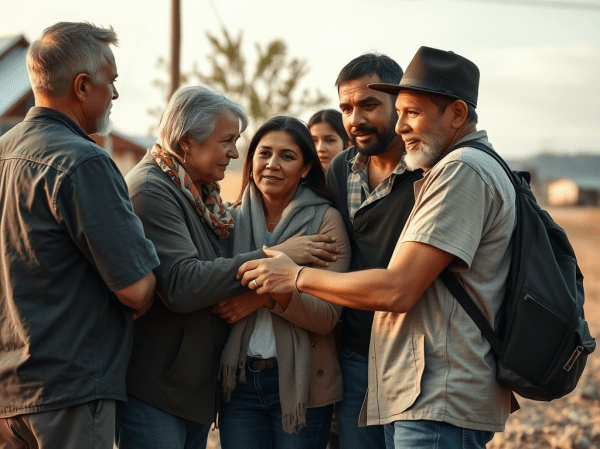
In ancient times, people viewed the mind through the heart. Titus Lucretius Carus, Roman poet and philosopher, once wrote:
“Watch a man in times of adversity to discover what kind of man he is; for then at last words of truth are drawn from the depths of his heart, and the mask is torn off.”
This truth still holds. We don’t find out who we are in our comfort—we find out in the fire.
Not the moment we snap out of exhaustion. Not the frustration at a coworker But the moment when everything is on the line.
When the stakes are life and death—what road do we choose? Do we harm to survive, or find a way to love? Do we shield our own at the cost of others, or listen for a better way?
I pray I never face that kind of test. But if I do, I trust that God will lead me. And I pray I’ll have the wisdom to follow.
✨ What do you believe we carry into those moments? Where does your strength come from when everything else is stripped away?
Los Angeles is burning again. Police cars overturned. Flags defaced. Crowds in the streets — not marching in protest, but surging in anger, demanding open borders and shouting down the idea of enforcement as if laws themselves were the enemy.
Watching this unfold, I feel the knot rise in my chest.
And I think of my father.
He came to this country in 1947 — not because he was poor, though he was. Not because he was afraid, though he had every reason to be. He came because the place he was from had been obliterated.
He was German. He was Jewish.
And in post-war America, that made him suspect from every direction. Some hated him for being German — the enemy. Others distrusted him because he was a Jew — even though that identity had nearly cost him his life.
The war may have ended, but the distrust lingered. America was eager to move on, but not yet ready to embrace the displaced — especially not the ones who blurred the lines between categories we find easier to hate.
“Many who sought a safe haven from persecution during the 1930s and 1940s found their efforts thwarted by the United States’ restrictive immigration quotas and the complicated, demanding requirements for obtaining visas. Public opinion in the United States did not favor increased immigration…” — United States Holocaust Memorial Museum
That was the world my father stepped into. And it’s the world he had to navigate with quiet strength, resilience, and humility.
He didn’t sneak in. He didn’t demand to be taken care of. He secured a sponsor. He filed the paperwork. He paid the fees. He arrived in New York on the USS Bremen and stood in line at Ellis Island, waiting for this country to say yes.
By 1951, he was wearing a U.S. uniform — a baker in the Korean War — feeding the soldiers of a nation still unsure if it wanted him. That’s the legacy I come from.
So when I see angry mobs insisting that compassion means erasing process, I feel that old ache and a rising frustration. I understand the longing to come here. I really do. America still shines with promise.
But I also understand the cost of doing it right. The patience. The grit. The sacrifice.
My father didn’t demand America bend to him. He bent himself toward her promise.
I believe in compassion. I believe in mercy. But mercy without structure is not mercy. It’s mayhem.
This country needs rules. Because without rules, there is no justice. And without structure, there is no sanctuary.
We owe it to those who came through the fire — not to burn down the country that gave them shelter, but to protect it for those still coming.
Not through entitlement. Not through rage. But through honor.
Lately, I’ve been pondering something strange but persistent: in my dreams, I’m never my current self.
Not in age. Not in weight. Not in health or hesitation.
I’m always… well, me—but the version of me that feels most like me. No back pain. No fatigue. No awareness of aging. I don’t second-guess what I’m capable of. I just am. Strong, moving, doing, becoming.
It made me wonder—do our brains hold onto some internal image of ourselves, some subconscious blueprint that gets locked in around age 25?
Science has some thoughts on that.
By our mid-20s, our prefrontal cortex—the part of the brain responsible for decision-making, self-awareness, and our sense of identity—is fully developed. After that, the architecture is in place. The rest is refinement. That’s also the season of life when many people settle into who they believe they are and what they’re here to do.
Psychologists call it narrative identity—that invisible thread we use to stitch our life story together. And once we find that thread, we tend to hold onto it. Even if our bodies change. Even if time marches on.
So maybe, when we dream, we return to that version. The most whole version. The one that feels like freedom. Like purpose. Like us at full capacity.
And here’s the deeper layer I’ve been turning over: What if that version is more than just a psychological default?
What if that’s our soul’s imprint?
What if that “ideal self” we return to in dreams—the one without limits or fear or fatigue—is a glimpse of who we really are, eternally? The version Heaven holds. Not in vanity, but in essence. Whole. Restored. As we were meant to be before time and gravity got their say.
Maybe the reason I always dream as my younger, healthier self isn’t just nostalgia. Maybe it’s memory. Soul-memory. A whisper from eternity that says: This is still you.
Because even as our bodies age, something inside us never does. Something eternal remembers.
And when the world fades—when these earthly bodies fall away—maybe that’s the version of us that remains. The soul, shaped in love, refined by fire, and finally free.
So I ask you: If you had to picture your truest self—the one that might walk into Heaven tomorrow— What would she look like?
What age would she be?
Would she still carry worry? Or would she finally be light?
—
🌀 Just something I’m pondering. Maybe you are too.
The old hatred—dressed in new clothes—marches forward like it never left.
I keep hearing the same hollow justifications, the same twisting of truth, the same whispers turned to shouts. And this time, it’s not whispered in back rooms. It’s livestreamed. Painted on walls. Shouted in the streets of major cities. And worse—justified by people who claim to care about justice.
But you can always tell when something is older than we are. This isn’t just politics. It’s spiritual.
It’s the same serpent from Eden. The same spirit behind Pharaoh, Haman, Hitler. It slithers through time, striking again at the people God chose to bear His name.
Yes—chose.
Not for dominance. Not for perfection. But for covenant.
The children of Abraham weren’t selected to be untouchable—they were chosen to be a thread. A promise. A light. And light, by its nature, reveals what darkness tries to hide.
I think of what Adonai said to Abraham:
“I will make you into a great nation, and I will bless you… and all peoples on earth will be blessed through you.” (Genesis 12:2–3)
That promise wasn’t revoked. Not with exile. Not with crucifixion. Not with conquest. Not even with genocide.
It still holds.
And I feel the weight of it again—watching history bend toward the same old pattern. As if we haven’t learned a thing.
We forget the Holocaust while survivors still breathe. We twist history to fit our hashtags. We speak of justice, while ignoring the literal blood spilled on synagogue floors.
So what do we do?
We bless.
We stand in that ancient flow and speak what was always meant to be spoken:
May the Lord bless the children of Abraham. May He guard their hearts and minds. May He surround them with fire by night and cloud by day. May He call to the descendants of Isaac, and the scattered ones of Jacob, and those grafted in by grace— and remind them they are not forgotten. Not forsaken. Not alone.
And may we, those watching, never close our eyes. Not this time.
Lately, I’ve been thinking about needs. Not just mine, or yours—but ours.
It started when I realized how often people walk around half-seen, half-heard, hoping someone notices. Not always crying for help—just… hoping. Hoping for a glance. A nod. A moment of shared air where someone says, “I see you.”
That’s what led me back to the idea of synchronicity— Those “divine appointments” we don’t plan but somehow show up at the exact right time. You run into an old friend at the store. You feel prompted to text someone you haven’t thought of in years—and they reply, “How did you know?”
Call it coincidence. Call it the Holy Spirit. Call it the golden thread that runs quietly through this loud, chaotic world. But I think there’s something we’re meant to notice here.
We are wired—designed—to care for one another.
And here’s the question I’ve been sitting with:
Why do we expect the government to do the job we were called to do?
Big government steps in, and all too often, it brings fraud, waste, and strife. The role of government is to protect its people—that’s it.
The rest? That’s on us.
It’s our job—mine and yours—to look out for one another. To see. To notice. To respond.
Because the very first human question in Scripture was this:
“Am I my brother’s keeper?” (Genesis 4:9)
It was meant as a dodge. A way to distance, to dismiss, to deflect.
And God doesn’t even answer directly—because the answer was always supposed to be obvious.
Yes. Yes, you are.
I know—it’s complicated. Cain chose violence over love. Humanity hasn’t always chosen well.
But let’s set aside the extremes. Forget the small percentage who are truly broken, who live without empathy. That’s not who I’m talking about.
I’m talking about the rest of us.
The ones who walk by someone in need and think, “Get a job.” “Work harder.” “What did you do to get yourself into this mess?”
Instead of simply asking: “How can I be here for you?” “What do you need?” “I see you. I’m here.”
Let this be in you…
Jesus didn’t wait for a policy. He didn’t start a committee. He saw, and He moved.
He interrupted His own plans to meet needs others walked past. And that’s the mindset we’re invited to share.
So here’s your challenge: Before you walk by, scroll past, or tune out… pause. Ask: Is this a need I was meant to notice?
Because the Spirit leads, often quietly. And sometimes the only miracle needed is your presence.
Be the keeper. Be the neighbor. Be the one who sees.
I have to admit—ever since COVID, I really don’t like being around people.
Not because I’m afraid of getting sick. It’s not that.
It’s just that when we were all closed in, I found it peaceful. Like… too peaceful. And I realized I didn’t need all that interaction.
But I also know—that’s not what we’re called to.
People are good for us, believe it or not. Even though, honestly, most people are assholes.
Still, God calls us to work with each other. To be with each other. And most often, to connect with each other.
That doesn’t mean we have to be all up in each other’s faces 24/7. But it does mean we need to be available to one another.
Lately, I’ve been thinking a lot about synchronicity.
It’s one of those beautifully weird concepts that Carl Jung brought into the psychological world—a kind of “meaningful coincidence” that isn’t caused by one thing triggering another but still feels undeniably connected. Like the universe winks at you. Or God whispers, “See? I’m here.”
And honestly? I’ve come to believe synchronicity might be one of God’s native languages.
It’s not loud. It’s not linear. It’s subtle. Personal. Often wrapped in timing you can’t explain and symbolism you can’t shake.
It’s when something small and unexpected helps you find the thread again— the one that reminds you life isn’t random. That you’re not drifting.
That connection still exists— in quiet places and in very loud places.
And sometimes, it shows up in the middle of Target.
I’m one of those people strangers talk to. And I don’t mean just polite, “how ’bout this weather” stuff. Nope. People will start telling me their life stories. Right there. Aisle seven. No warm-up.
It’s like I have a stamp on my forehead that says, “Psychologist—Speak Here.”
And depending on my schedule… and my mood… I’ll engage.
Sometimes I’m all in—heart open, listening. Other times, I’m mentally scrolling my to-do list and praying for a graceful exit. But either way, I know those moments aren’t just random.
There’s a thread there. And I think… maybe these are God’s divine appointments. And I should pay attention.
Maybe they just need someone to see them. To care. Perhaps I can refer them to someone—or help them right there. I’ll never know unless I’m open to the moment.
But here’s your WARNING: You’ve got to be spiritually in tune when dealing with strangers.
Because remember what I said earlier—some people are assholes. They will take advantage of your kindness. And some, unfortunately, may even mean you harm.
Discernment matters. Compassion isn’t foolish—but it is vulnerable. So stay rooted. Stay wise. Stay awake.
How, might you ask?
Well, that goes back to living your truth.
I happen to be a trained counselor—but I was also born with this gift. Jerry was born with a velvet hammer. He’s diplomatic and still gets the point across. Another friend of ours is a genius with machines—that’s his gift. Another is calm in emergencies. And so on…
God blesses each of us with something we’re good at. It could be something as quiet and powerful as the gift of listening.
So, if God is going to make a divine appointment for us, it will most likely be to use the gifts He’s given us.
Be open. Ask: “God, is this what You want?” And then—act.
Thread or Tangle?
The next time someone unexpectedly speaks to you—whether in the grocery store, at the gas pump, or while waiting in line—pause for just one moment.
Instead of reacting with annoyance, curiosity, or concern, try asking yourself:
🧵 “Is this a thread… or a tangle?”
If it’s a thread, it may be part of a divine appointment—a moment stitched into your day for a reason.
If it’s a tangle, it might still hold purpose—but it requires discernment to gently unravel without getting caught in it.
Then reflect:
Am I showing up as the person God gifted me to be in this moment?
Is this encounter calling forth my strength… or testing my boundaries?
Can I connect with compassion without losing clarity?
“Let this mind be in you, which was also in Christ Jesus…” —Philippians 2:5
Christ wasn’t swayed by every voice—but He never missed the voice He was meant to hear. Stay open. Stay wise. Stay willing. And trust that even the threads that appear frayed may be part of something beautifully woven.